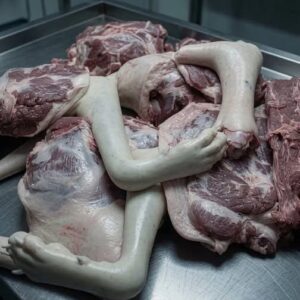
I peeled open the package of bacon expecting nothing more than breakfast.
Instead, my stomach dropped almost instantly.
Something inside the pack looked completely wrong.
Between the neatly stacked pink strips of bacon sat a pale, thick chunk that didn’t resemble anything I expected to see in packaged meat. It looked dense, oddly smooth in some places and rubbery in others, with a shape so strange and unnatural that my brain immediately rejected it. For a moment I just stared at it in silence, trying to convince myself there had to be a simple explanation. But the longer I looked, the more unsettling it became.
My appetite disappeared immediately.
A wave of panic and disgust hit me all at once.
The object looked too solid to be fat, too pale to be normal meat, and too strangely shaped to ignore. My mind started racing through every horrifying possibility imaginable. Was it plastic? Some kind of contamination? A parasite? Part of a machine? Something artificial accidentally sealed into the package during processing? Suddenly every disturbing story I had ever heard about industrial food production came rushing back into my head at once.
I stood frozen in my kitchen holding the open package, unable to stop staring.
The worst part was how unfamiliar it looked. Most people are used to seeing food only after it has already been cleaned, trimmed, sliced, packaged, and made visually acceptable. Bacon usually arrives looking uniform and predictable—pink meat, white fat, tidy strips. But this thing interrupted that illusion completely. It looked raw in a way people are not emotionally prepared to see anymore.
For several minutes I debated whether to throw the entire package away immediately.
Part of me wanted to seal it in another bag and never look at it again.
But curiosity eventually overpowered panic.
I grabbed my phone and started searching online.
At first, that only made things worse. Images of food contamination, strange processing accidents, parasites, and factory horror stories filled the screen. Forums were packed with people posting mysterious objects found in packaged meat, and every comment section contained someone convinced they had nearly eaten something dangerous. The deeper I searched, the more anxious I became. Every photo started looking similar to the chunk sitting in my own kitchen.
I zoomed in on the object again.
The texture looked thick and connective, almost like dense rubber. It didn’t resemble muscle tissue at all. That detail alone sent my imagination spiraling even further. I kept thinking, what if this isn’t even meat anymore? What if I’m looking at something that was never supposed to reach consumers at all?
Hours later, after comparing images, reading explanations from butchers, and scrolling through endless discussions, the answer finally emerged.
And strangely, it felt both relieving and unsettling at the same time.
The object was most likely cartilage — a chunk of connective tissue from the pig that accidentally slipped through during processing. Not plastic. Not a parasite. Not some horrifying foreign object. Just an unusually large piece of tissue that normally gets trimmed away before packaging.
Technically harmless.
Still disgusting.
The relief came first. At least I hadn’t discovered some dangerous contamination or evidence of a major food safety disaster. But once the panic faded, a different feeling replaced it — discomfort. Because the incident forced me to confront something most people rarely think about: packaged meat comes from actual bodies, and sometimes traces of that reality slip through the polished presentation we are used to seeing.
Modern food packaging creates distance.
Most consumers never see connective tissue, cartilage, organs, bones, or the less appealing parts of animal anatomy anymore. Grocery stores present meat in clean, symmetrical cuts designed to feel disconnected from the animal itself. As long as everything looks smooth and familiar, people stay comfortable. But the moment something appears slightly more “real,” even if it’s harmless, it suddenly becomes deeply disturbing.
That realization stayed with me longer than the initial fear.
The experience wasn’t just about one strange object inside a bacon package. It was about how disconnected many people have become from the reality of food production. We want meat to appear clean, perfect, and almost artificial. We enjoy eating it, but often don’t want reminders that it came from living tissue with bones, joints, cartilage, and imperfections.
In a strange way, the scariest part wasn’t the object itself.
It was realizing how little most of us actually know about what our food naturally looks like before processing hides the uncomfortable details.
I still threw that package away.
Not because it was dangerous, but because my appetite was completely destroyed by then.
And honestly, every time I open a pack of bacon now, there’s always a tiny moment where I hesitate before looking inside.